
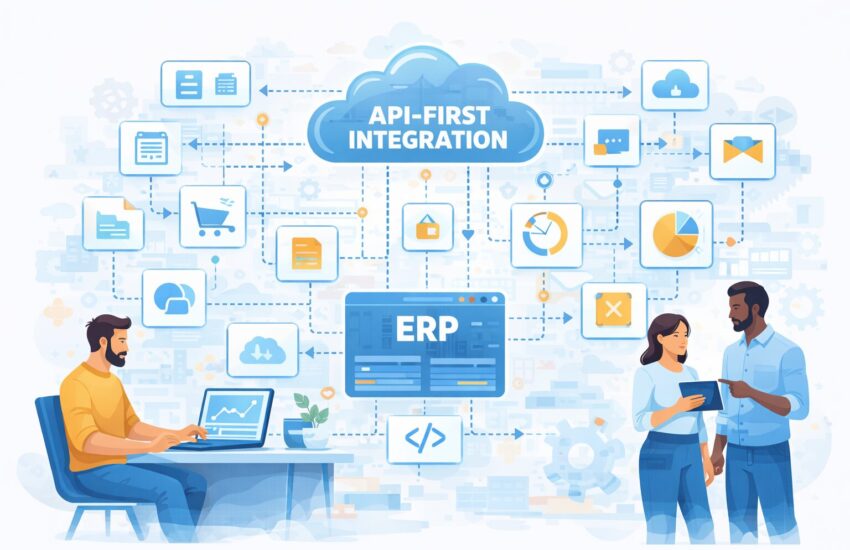
Enterprise Resource Planning (ERP) is no longer a back-office system. By 2026, contemporary businesses use an interconnected digital ecosystem, comprising CRM software, eCommerce platforms, payment gateways, logistics companies, analytics applications, and third-party applications. The core of this development is API-first integration, a design model that is fundamentally changing the nature of how ERP systems integrate, scale, and add value.
The trend is especially apparent in such platforms as Odoo, where ERP API integration allows conducting deployments more quickly, with real-time data flow, and future-proof architectures. This guide will discuss the meaning of API-first integration, why it is important to ERP systems, and how it is transforming the ERP relationships of contemporary enterprises.
What Is API-First Integration?
API-first integration is an architectural approach where Application Programming Interfaces (APIs) are designed and developed before the actual application or user interface. Instead of building software first and adding APIs later, APIs become the foundation of the system.
What is API-first integration in simple terms?
It means:
- APIs are not an add-on, but are considered core products.
- With standardized APIs, all systems (ERP, CRM, mobile apps, partners) interact.
- Integration will be implemented when it starts,s not retrofitted.
This strategy provides scalability, flexibility, and consistency- the main needs of a contemporary ERP environment.
What Is an API in ERP?
A secure interface in ERP is known as API, and this enables the ERP system to interact with other applications, services, or platforms. APIs enable data exchange without manual intervention.
Common ERP API use cases:
- Aligning customers between CRM and ERP
- Linking ERP and payment gateways or banks
- Combining inventory and eCommerce networks
- Workflows Automation of order-to-cash.
These integrations are more reliable, faster, and easier to maintain with API-first ERP.
Reasons Why ERP Integrations No Longer Work.
Legacy ERP integrations were often:
- Point-to-point
- Hard-coded
- Difficult to scale
- Expensive to maintain
These inflexible integrations become a bottleneck as businesses use cloud-native and microservices.
Key limitations of traditional ERP integration:
- Close system integration.
- Poor real-time functions.
- During ERP upgrades, a high risk exists.
- Poor developer experience
The API-first integration addresses these problems by adding standard, reusable, and well-documented interfaces.
How API-First Integration Is Changing ERP Connections
1. Decoupling ERP from Frontend and External Systems
API-first ERP designs separate the ERP core from:
- Web portals
- Mobile apps
- Partner systems
- Industry-specific tools
This enables enterprises to move their user experiences without accessing ERP core logic.
2. More Flexible and faster ERP API integration.
With standardized APIs:
- Integrations are reusable
- New tools are capable of being connected rapidly
- ERP renewals do not disrupt existing interconnections.
That is why the Odoo ERP integration services are becoming more based on the REST API and the architecture based on the webhook.
3. Live Data Interchange between Systems.
API-first integration enables real-time synchronization of:
- Sales orders
- Inventory levels
- Customer data
- Financial transactions
This enhances visibility of operations and decision-making.
API-First ERP vs Traditional ERP Integration
| Feature | Traditional ERP Integration | API-First ERP Integration |
| Integration Approach | Point-to-point | API-centric |
| Scalability | Limited | High |
| Real-time Data | Rare | Standard |
| Upgrade Safety | High risk | Low risk |
| Developer Experience | Complex | Simplified |
| Cloud Readiness | Low | High |
This comparison highlights why API-first ERP is becoming the default integration strategy.
What Are the 4 Types of API Used in ERP Systems?
The knowledge of the types of API assists companies in selecting the appropriate ERP API integration strategy
1. REST APIs
- Well-known in contemporary ERP systems
- Lightweight and scalable
- Highly used in Odoo ERP integration services
2. SOAP APIs
- Older but still used in legacy ERP systems
- More rigid and complex
3. GraphQL APIs
- Flexible data querying
- New in advanced ERP architecture.
4. Webhooks (Event-driven APIs)
- Push-based notifications
- Perfect in the case of real-time automation of ERP.
The majority of current ERP systems prefer REST APIs with webhooks as an event-driven workflow.
API-First Integration in Odoo ERP
Odoo is a strong example of an ERP platform built for API-driven extensibility.
Why Odoo supports API-first ERP integration:
- Robust REST APIs
- Modular architecture
- Strong community and documentation
- Seamless integration with CRM, eCommerce, and accounting software.
Those businesses that use Odoo integration services can integrate Odoo with:
- Salesforce
- Shopify
- Payment gateways
- Logistics platforms
- BI and analytics tools
This is why Odoo is suitable to API-first ERP strategies. For more technical insights and detailed guidance on integrating Odoo with external applications, visit the official Odoo Documentation.
Advantages of Unified API for CRM ERP Integration
The ability to provide a single API layer between the CRM and ERP systems provides quantifiable business value.
Key benefits include:
- One location of customer information.
- Automated lead-to-order workflows
- Live sales and inventory.
- Reduced manual data entry
- Better customer experience.
It is these advantages that enable the increasing demand for Odoo ERP integration services, which are concerned with CRM-ERP alignment.
Security and Governance in ERP API Integration
API-first does not mean sacrificing security. Modern ERP API integration includes:
- OAuth 2.0 authentication
- Role-based access control
- Rate limiting
- API monitoring and logging
The practices provide enterprise-level security and offer agility.
In what cases should API-First ERP Integration be used by Businesses?
The API-first ERP integration would be the best choice when:
- You make use of various cloud applications.
- You plan frequent system upgrades
- You desire real-time data visibility.
- You aim to future-proof your ERP ecosystem
The API-first integration is not an option anymore; it is a strategy needed by growing organizations.
Best Practices in a Successful ERP API Integration.
- Design APIs with clear documentation
- Use versioning to avoid breaking changes
- Monitor performance and error logs
- Follow REST standards consistently
- Select knowledgeable Odoo integration services partners.
The practices provide scalable and sustainable integrations.
For a practical, step-by-step breakdown of connecting Odoo with external systems, explore our detailed guide on Odoo integration made simple.
Conclusion
The API-first integration is transforming the integration of ERP systems in terms of connection, scaling, and evolution. APIs enable businesses to be more flexible, more resilient, and have a real-time view of their digital ecosystem by prioritizing APIs as the basic building blocks. It can be used to facilitate a smooth CRM alignment process, to act as a supportive component of the cloud-native technology, or to hedge against future ERP investment risks, but in any case, ERP API integration has become a strategic requirement and not a technical choice.
With Odoo in use with organizations, the adoption of API-first principles via professional Odoo ERP integration services will be faster to innovate, safer to upgrade, and can be scaled in the long term. As ERP ecosystems continue to expand, API-first integration will remain the backbone of modern, connected enterprises.
Frequently Asked Questions (FAQs)
1. What is API-first integration in ERP?
API-first integration in ERP means designing and exposing APIs before building applications, ensuring seamless connectivity with CRM, eCommerce, and third-party systems.
2. What is an API in ERP systems?
ERP API is an interface that enables the ERP to interact with other applications safely and in real time.
3. What are the 4 types of API used in ERP integration?
The four common types are REST APIs, SOAP APIs, GraphQL APIs, and webhooks (event-driven APIs).
4. How does API-first ERP benefit CRM integration?
The API- First ERP will allow real-time CRM- ERP data synchronization, consolidated customer records, automated business processes, and an improved view of sales.
5. Why are odoo integration services important for API-first ERP?
Professional Odoo integration services ensure secure, scalable, and upgrade-safe ERP API integration tailored to business workflows.