
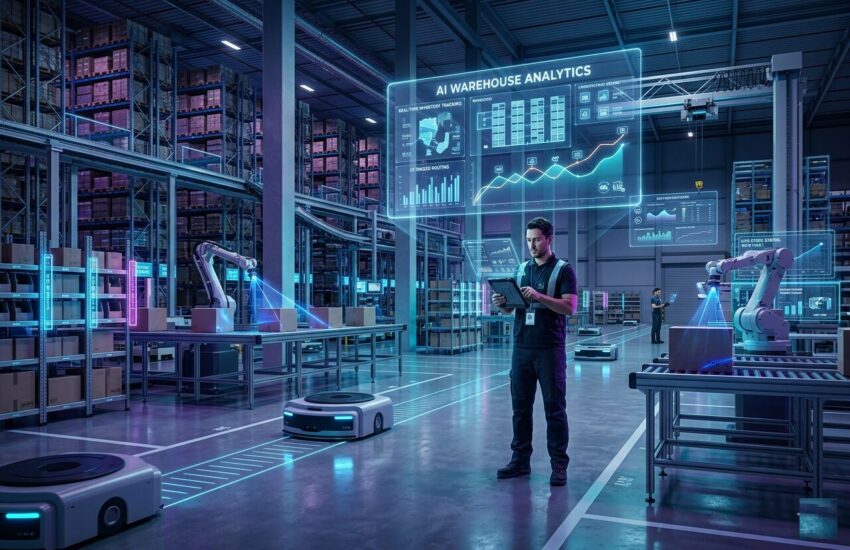
If you’ve managed inventory manually even once, you already know the drill. You finish a stock count, update the system, and by the time you’re done, something’s moved, something’s missing, and your numbers are off again. Nobody made a mistake on purpose. That’s just what happens when busy warehouses run on manual processes.
A smart warehouse management system exists to fix exactly that. Not in a dramatic way. In a quiet, steady, “we-actually-know-where-our-stock-is” kind of way.
AI has changed what warehouse operations can look like. Businesses that have made the shift report fewer errors. They enjoy faster order fulfillment. Inventory data reflects reality. This blog covers what that shift looks like in practice, why Indian businesses are moving fast on it, and what to think about before you start.
What Is a Smart Warehouse Management System?
Here’s the thing about older warehouse management systems. They were better than paper, sure. But they were still reactive. You’d get a digital record of what happened. You’d find out about problems after they happened.
A smart warehouse management system works differently. It doesn’t just record activity. It learns from it. Over time, it picks up patterns in your orders, your stock movement, and your seasonal spikes, and it uses that to help you get ahead of problems rather than chase them.
The difference comes down to one word: anticipation.
| Feature | Traditional WMS | AI-Powered Smart WMS |
| Inventory tracking | Periodic or manual | Real-time, automated |
| Demand planning | Historical averages | Machine learning forecasts |
| Error detection | Reactive | Proactive alerts |
| Order routing | Rule-based | Dynamic and intelligent |
| Integration | Often siloed | ERP, CRM, IoT-connected |
The core components of a modern system include:
- Real-time inventory tracking,
- Automated order management,
- Demand forecasting, and
- Supply chain integration.
Automated warehouse systems handle repetitive tasks like scanning, sorting, and routing. That frees up your people to focus on exceptions instead of routine.
And Indian businesses are moving in this direction, especially in e-commerce and third-party logistics. Compressed delivery timelines have made smart warehousing solutions less of an upgrade and more of a requirement.
Role of AI in Modern Warehouse Operations
AI is an overloaded word. So let’s keep this specific. In warehouse operations, it mostly comes down to three technologies working together.
Machine learning for demand forecasting.
The system analyzes your historical data, order patterns, supplier lead times, and seasonal behavior. Then it tells you what you’ll need before you need it. Stock balancing is genuinely one of the hardest problems in logistics. Do it manually, and you’ll almost always end up with too much of the wrong thing or not enough of the right thing.
Computer vision for inventory tracking.
Cameras and sensors identify items, read barcodes, and verify shelf counts without anyone walking the floor. Think about a fulfillment center during peak season. A single miscounted shelf can trigger a chain of wrong orders. Computer vision is what stops that from happening quietly and consistently.
Robotics for picking and packing.
Automated guided vehicles and robotic systems handle repetitive tasks faster and with fewer errors. This doesn’t eliminate warehouse jobs. But it changes what those jobs involve.
Together, these enable real logistics process automation. Not just digitizing existing workflows, but rethinking how the whole operation runs. AI-driven logistics optimization means smarter routes, dynamic labor allocation, and nothing falling through the cracks between receiving and dispatch.
Key Benefits of AI-Powered Warehouse Management Systems
Improved Inventory Accuracy
Manual counting isn’t the problem. Human fatigue is. Repetitive tasks at volume produce errors. That’s not a people problem, it’s a process problem.
AI tracking systems maintain accuracy continuously. Not just when someone schedules a count. So your inventory data actually reflects what’s on the shelf. Which sounds basic, but for most operations, it’s a significant shift.
Faster Order Fulfillment
Automation in picking, packing, and dispatch reduces the gap between order received and order shipped. And in a market where delivery speed is a competitive factor, that gap matters. Reducing turnaround time affects customer satisfaction directly. It also affects how many orders you can process without adding headcount.
Better Inventory Turnover
This is where AI warehouse management software does quiet, consistent work. It helps you avoid the two inventory problems that drain cash: slow-moving stock sitting on shelves, and fast-moving stock running out at the wrong time.
Improving inventory turnover reliably, not just in a good quarter but as a consistent operational outcome, is one of the clearest financial wins these systems deliver.
Cost Reduction and Operational Efficiency
Labor optimization here means putting people where their judgment adds value, not on tasks a machine handles better. Wastage from expired, lost, or misplaced stock also drops. That adds up faster than most businesses expect.
Enhanced Decision-Making
Clean, current, connected data produces better decisions. That’s almost too obvious to say. But most warehouses are still making calls based on data that’s hours or days old. Smart supply chain solutions change that baseline. Business intelligence tools can surface insights in real time that would otherwise take days to compile.
AI in Inventory Management: A Game Changer
Predictive analytics for stock levels is probably the highest-impact application of AI in warehouse operations. A system that can model seasonal demand, factoring in last year’s patterns, current sales velocity, and regional behavior, is doing something no spreadsheet can match.
Here’s a simple example. A consumer goods distributor heading into the festive season used to over-order on some SKUs and under-order on others, then scramble to fix both problems at once. With an AI-driven system in place, orders are based on forecasts that factor in dozens of variables at the same time. Overstocking drops. Stockouts drop. Cash stops sitting in a warehouse doing nothing.
Seasonal forecasting, avoiding inventory extremes, and inventory turnover improvement strategies are where AI delivers measurable ROI fastest. And the system keeps getting better as it learns your business patterns over time.
Intelligent Warehouse Automation: The Future of Logistics
Beyond software, intelligent warehouse automation includes physical systems. Conveyor belts with smart routing, robotic picking stations, and automated sorting for dispatch. These work best when connected to IoT sensors that give the system real-time awareness of where everything is.
For e-commerce and manufacturing, the ability to scale operations without scaling headcount proportionally is a meaningful advantage. A warehouse that handles double the volume during peak periods without doubling its hiring is a different kind of operation entirely. That’s what warehouse automation services make possible.
And these technologies don’t work in isolation. Robotics, smart picking systems, and IoT integration are most effective when connected through a central AI platform. The combined effect is considerably larger than any single piece.
Challenges in Implementing AI in Warehouse Management
Let’s be straightforward here. This transition comes with real friction.
The upfront investment is significant. Integrating new platforms with legacy ERP or older WMS systems takes work. Data quality problems, inconsistent SKU codes, historical gaps, and outdated master data, these can quietly undermine forecasting models if they’re not fixed before go-live.
There’s also the workforce side. These tools require people who understand how to use them. That means training, and sometimes new hires.
But here’s the thing: none of these are reasons to avoid the transition. There are reasons to plan it carefully.
This is where warehouse management consulting services make a real difference. A good consulting partner helps you find gaps before implementation starts, manage integration complexity, and avoid the data problems that kill projects that looked fine on paper.
Choosing the Right Warehouse Management Services Provider
The criteria matter more than the pitch deck. A few things worth examining closely:
- Industry expertise. A pharmaceutical cold-chain warehouse has nothing in common operationally with an apparel fulfillment center. Providers who’ve worked in your vertical understand the nuances that generic implementations miss.
- Customization capability. A system that forces you to change how you work to fit its logic rarely performs as well as one built around your actual operations.
- Integration support. Your WMS needs to communicate with your ERP, your carrier systems, and often your customers’ platforms. Warehouse management system implementation succeeds or fails on this point more than any other.
- End-to-end service. Look for warehouse automation services that cover deployment, training, and ongoing optimization. Not just a software handoff and a manual.
For businesses identifying the best warehouse management service provider in India, prioritize documented implementations in operations similar to yours over impressive feature lists.
Why Businesses in India Are Adopting AI-Based Warehouse Systems?
India’s e-commerce growth has created a specific kind of operational pressure:
- Large geographic spread,
- Complex last-mile logistics, and
- Fast delivery as a baseline service.
These scenarios make manual warehouse operations unsustainable.
Ahmedabad, Mumbai, and Bangalore are seeing genuine investment in warehouse infrastructure upgrades. And it’s not just large enterprises making the move. Mid-size businesses are doing it too. Because the gap between what customers expect and what manual systems can deliver has grown too wide to manage.
So the competitive angle here is worth noting. Businesses that automate now are building an advantage that’s difficult for late movers to close quickly. Smart supply chain solutions aren’t just about running more efficiently. They’re about staying relevant in a market that keeps moving faster.
Future Trends in AI Warehouse Management
Here’s the thing: a lot of this isn’t the future anymore. It’s already happening in larger operations. But for most businesses, these shifts are still coming.
A few directions worth paying attention to:
- AI and IoT are working together. Every shelf, vehicle, and dock door feeds data into one system. In real time. You’ll notice the difference when managers stop reading morning reports and start watching live dashboards.
- Autonomous warehouses. Routing, restocking, and dispatch sequencing are handled by the system. Humans shift to oversight. It sounds ambitious, but it’s already running in some facilities.
- Real-time analytics as the new baseline. Most warehouses today work off data that’s hours old. That’s going to feel increasingly inadequate, and soon.
- Hyper-personalized supply chains. AI lets businesses build differentiated logistics flows for different customer segments. Not one process for everyone.
- Sustainable warehousing. Optimized routes, lower energy use, and less wastage. Environmental performance is becoming a real factor in vendor decisions, not just a talking point.
- Predictive maintenance. Equipment failure mid-shift is expensive. AI flags problems before they happen, based on usage patterns and sensor data.
So the direction is clear. More automation, better visibility, and systems that handle routine decisions well. The businesses building these capabilities now will be meaningfully ahead. And that kind of gap tends to compound over time.
How ERPOcean Helps Businesses Transform Warehouse Operations?
ERPOcean works with businesses across industries to design and implement warehouse management solutions built around actual operations, not ideal ones.
The process is end-to-end.
- Scoping. They start by understanding your actual operation, not a generic warehouse template.
- Implementation. Built around how your business works, not the other way around.
- ERP and CRM integration. Your existing systems stay connected. Nothing runs in isolation.
- Post-deployment support. Because real-world use always reveals things a plan didn’t cover. So you’re not left figuring it out alone after go-live.
And their approach is industry-specific. Because a manufacturing business, a 3PL, and an e-commerce brand have genuinely different requirements. Those differences need to be built into the solution from the beginning, not patched in later.
If you’re evaluating options or just trying to understand what this kind of transition would involve for your business, the contact page is a good place to start.
Conclusion
AI-powered warehouse management has moved from experimental to practical. Businesses adopting it now aren’t doing so because it’s trendy. They’re doing it because it solves real problems: inventory that’s inaccurate, fulfillment that’s too slow, and demand planning that relies more on guesswork than data.
The transition takes effort. But the gap between operations running on smart systems and those still running manually is widening. And it won’t close on its own. The businesses that modernise now are the ones that stay competitive when conditions tighten.