
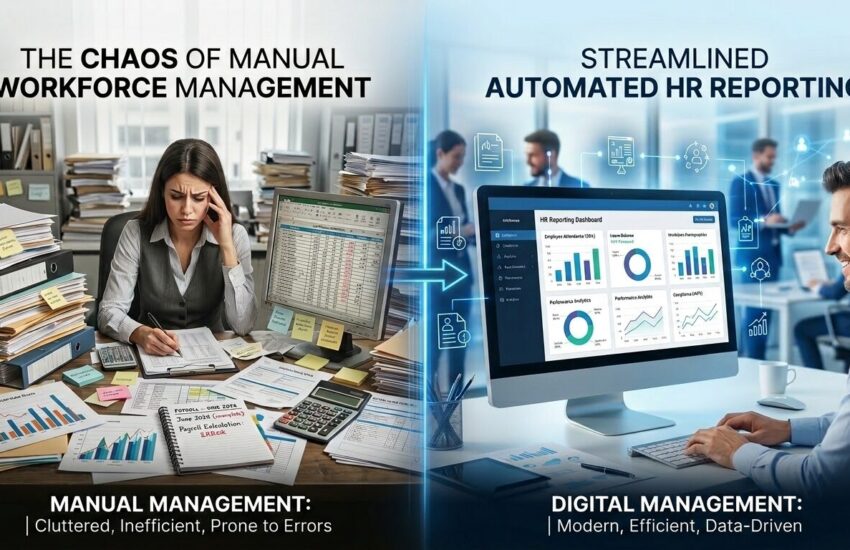
Many HR leaders say that poor data quality is one of the biggest barriers to making good workforce decisions. That fact is hard to ignore. Behind every missed deadline, every payroll error, and every compliance gap – there is often one common cause: manual HR reporting that was never built to keep up with how businesses actually work today.
HR reporting is not just about numbers on a spreadsheet. It shapes hiring decisions. It drives payroll accuracy. It keeps your business on the right side of labour laws. When that reporting process depends on people doing things by hand, the risks stack up quietly – until one day, they do not.
This blog breaks down the most pressing HR management challenges that come with manual workforce reporting. We will also look at why these problems keep showing up and what modern teams are doing differently. If you are still running HR on spreadsheets and manual entries, this is worth your time. Let’s get started:
Understanding Manual Workforce Reporting Systems
Manual workforce management refers to any HR process that depends on human input without system automation. Think spreadsheets, paper forms, shared drives, and email threads that hold employee data. A lot of small and mid-sized companies still run this way.
The problem is not that these tools exist. The problem is that they were never designed to carry the weight of an entire HR function. Spreadsheet-based reporting requires someone to enter data, someone else to review it, and another person to pull it into a report. Each handoff creates a new chance for error.
Lack of integration between HR functions is another core issue. Your payroll data sits in one place. Attendance records live somewhere else. Performance notes are in a manager’s inbox. None of these systems talk to the others. That is what creates data silos in employee record management – and those silos slow everything down.
Delayed reporting cycles are a natural result of this setup. When reports take days or weeks to compile, the data is already outdated by the time anyone reads it. Decisions get made on old numbers. That is a problem no organisation can afford to ignore.
| Manual HR Practice | Reporting Problem It Creates |
| Spreadsheet attendance logs | Data inconsistency and duplication |
| Email-based leave approvals | No centralised record trail |
| Handwritten payroll entries | Calculation and compliance errors |
| Separate performance files | Fragmented employee evaluation data |
| Paper-based onboarding | Missing or incomplete employee records |
Inconsistent Employee Records and Data Duplication
Errors in employee documentation are far more common in manual setups than most people admit. A name spelled differently in two systems. A job title updated in one file but not another. A salary change that never made it into the main records. Each of these small gaps adds up.
Duplicate entries across departments are a bigger issue than they appear. When HR, finance, and operations each maintain their own records without a shared system, the same employee can have three different profiles – each with slightly different information. This way, audits become a nightmare and corrections take hours.
Misalignment in employee details directly affects audit readiness. Regulators and internal auditors expect consistent data. When records contradict each other, your team spends time explaining discrepancies instead of running the actual audit.
Centralized workforce information is not a luxury – it is a requirement for accuracy. The limitations of a basic attendance management system built on manual entries make this even worse. When attendance data is logged by hand, errors in leave balances, overtime tracking, and shift records become regular occurrences. That ripple effect touches payroll, compliance, and workforce planning all at once.
Payroll Reporting Errors in Manual HR Processes
Payroll calculation discrepancies are one of the most painful consequences of manual HR. A missed overtime entry. A deduction applied twice. A tax rate that was not updated after a regulatory change. These are not rare edge cases – they are predictable outcomes of any payroll management system that depends on manual inputs.
Statutory deduction mistakes create financial and legal exposure. When PAYE, provident fund contributions, or other mandatory deductions are calculated by hand, the margin for error is wide. Not only that, but these errors often go unnoticed for months before someone catches them.
Financial misreporting risks extend beyond internal headaches. Incorrect payroll figures can trigger audits, penalties, and employee disputes. The cost of fixing a payroll error after the fact is almost always higher than the cost of getting it right the first time.
Manual entry challenges also cause delays in payroll processing. When data needs to be collected, verified, entered, and checked across multiple people and systems, the process drags. Employees notice late payments. Trust in the HR function takes a hit. A proper payroll software solution removes these bottlenecks entirely by automating the calculation and verification steps.
| Payroll Error Type | Cause | Business Impact |
| Wrong deduction amount | Manual tax rate entry | Compliance risk, employee disputes |
| Duplicate salary payment | No system validation | Financial loss, reconciliation work |
| Missed overtime | Spreadsheet formula error | Employee dissatisfaction |
| Late payroll processing | Multi-step manual workflow | Low employee trust, HR credibility damage |
Compliance Reporting Challenges in Workforce Management
Labour law compliance is not a one-time checkbox. It requires ongoing tracking of working hours, leave entitlements, contract types, and statutory contributions. Manual processes make it incredibly difficult to stay on top of all these requirements consistently.
The risks of manual audit trails are significant. When compliance records are stored in spreadsheets or physical files, there is no reliable way to prove when a change was made, who made it, or why. That lack of traceability is a liability when regulators come knocking.
Missing documentation is another recurring issue. An employment contract that was never filed digitally. A training record that exists only in a manager’s notes. A policy acknowledgement that was signed but never stored. These gaps create real risk during compliance reviews.
Time-consuming regulatory reporting is a direct result of manual setups. Pulling together compliance reports manually takes hours of cross-referencing data from different sources. Human dependency in compliance processes means one person’s absence or error can delay the entire reporting cycle.
Real-time monitoring is practically impossible without automation. When you cannot see compliance status across your workforce at a glance, problems only surface after they have already become costly.
Performance Reporting Gaps in Employee Evaluation
One of the quieter HR management challenges is the lack of structured performance data. When performance reviews are conducted through email threads, paper forms, or informal conversations, there is no reliable record of what was discussed, agreed upon, or measured.
Subjective performance assessments become the norm in manual environments. Without clear metrics tracked over time, managers rely on recent memory and personal impressions. That leads to inconsistent evaluations and decisions that employees often see as unfair.
Reporting inaccuracies in workforce performance affect more than just appraisals. They distort workforce planning, promotion decisions, and training allocation. When you cannot trust your performance data, you cannot make good employee performance management decisions. That is a gap that costs businesses more than most people realise – especially in high-turnover industries.
Decision-making challenges compound over time. Leaders who lack clean performance data often default to gut instinct. This way, strong performers go unrecognised, and underperformance issues are addressed too late.
Productivity Tracking and Workforce Efficiency Issues
Limited visibility into workforce productivity is a defining feature of manual HR setups. When employee productivity tracking depends on manual time logs, manager observations, or end-of-month reports, the picture you get is always incomplete.
Difficulty in monitoring employee output is a practical problem for managers. Without real-time data, they cannot tell whether workloads are balanced, whether teams are overstretched, or whether certain tasks are consistently taking longer than they should.
Manual time-tracking errors add another layer of inaccuracy. Employees logging hours on paper or in shared spreadsheets often round up or down. Forgetting to log breaks is common. These small discrepancies accumulate into significant reporting gaps across a team.
Workforce performance evaluation gaps mean that HR teams often discover problems too late. By the time a manual report surfaces a productivity trend, the issue has already affected deadlines, team morale, or client delivery. A connected system would have flagged it weeks earlier.
| Tracking Area | Manual Method | Common Error | Reporting Gap |
| Working hours | Paper timesheets | Rounding and omissions | Inaccurate payroll basis |
| Leave usage | Email requests | Not recorded centrally | Leave balance errors |
| Task completion | Manager observation | Subjective reporting | Skewed performance data |
| Overtime tracking | Manual spreadsheet entry | Formula errors | Underpayment or overpayment |
Data Analysis Limitations in HR Reporting
Lack of predictive insights is a major cost of manual HR data analysis. When data lives in spreadsheets, there is no way to run trend analysis or forecast attrition, hiring needs, or skills gaps. You are always reacting – never planning ahead.
Workforce planning inefficiencies follow naturally. Without clean, connected data, HR teams struggle to answer basic questions like – how many people will we need in six months, or which departments are at risk of losing key talent. That uncertainty makes strategic planning very difficult.
Inability to generate real-time reports is one of the most cited frustrations in manual HR environments. Decision-makers have to wait for someone to compile a report before they can act. By then, the situation may have already changed.
Reporting errors due to manual inputs also undermine confidence in HR data across the organisation. When leaders have been burned by inaccurate reports before, they stop trusting the data. That distrust makes it harder to act on even reliable information when it finally arrives.
Lack of Automation in HR Reporting Workflows
Reporting delays are a predictable outcome of any HR function that lacks HR process automation. When every report requires manual data collection, formatting, and review, even routine reporting becomes time-consuming.
Dependency on manual approvals creates bottlenecks at every stage. A leave report waiting for a manager signature. A payroll summary held up because one team did not submit their hours. Workflow inefficiencies like these accumulate quickly in growing organisations.
Missed deadlines in workforce reporting are more than an inconvenience. Statutory reports submitted late can trigger fines. Internal reports that miss their window lead to decisions being made on outdated data. Therefore, the absence of automation does not just slow things down – it actively increases organisational risk.
When approval chains and reporting workflows are not automated, human dependency becomes a structural weakness. If the one person who knows how to compile the quarterly HR report is unavailable, the report simply does not happen. That is a fragility that no modern business should accept.
Technology Gaps in Workforce Reporting
Reporting inefficiencies due to outdated systems are something many HR teams live with for far longer than they should. Legacy tools were designed for smaller, simpler operations. As businesses grow, those tools buckle under the volume and complexity of modern HR needs.
Reporting delays in disconnected systems are a direct result of having no single source of truth. When your attendance data is in one tool, payroll data is in another, and performance records are in a third, pulling a unified workforce report means manually stitching together three different exports. Not only that, but each of those exports may be formatted differently.
Lack of integration between workforce processes means HR teams spend more time managing data than acting on it. Spreadsheet-based payroll tracking is a particular pain point – formulas break, version control becomes impossible, and errors compound across pay cycles.
The shift towards digital reporting tools – like an HRMS tool – is not just about convenience. It is about accuracy, speed, and the ability to see your entire workforce in one place. That visibility changes how HR teams operate and what they are able to contribute to the broader business.
Need for Modern Reporting Support in Payroll Operations
Growing payroll complexity is a reality for any organisation that is scaling. More employees mean more contracts, more deduction types, more compliance requirements, and more reporting obligations. Manual processes that worked for a team of 20 do not work for a team of 200.
The need for automated reporting support is clearest in payroll. With the best payroll software, calculations are automated, deductions are applied correctly, and reports are generated without anyone needing to compile them by hand. That removes entire categories of risk from the payroll process.
Risk mitigation in financial reporting is another strong argument for modernising payroll operations. Automated systems log every transaction, flag anomalies, and create a clear audit trail. When something goes wrong – and occasionally it will – the records are there.
The transition from spreadsheets to payroll software is not as difficult as many HR teams expect. Modern platforms are built to import existing data and go live quickly. The value is immediate – fewer errors, faster processing, and reporting that actually reflects what is happening in your business right now.
Building Reporting Accuracy Through Digital HR Ecosystems
Workforce transparency starts with having all your data in one place. When employee records, attendance logs, payroll data, and performance information are connected, HR reporting becomes something your business can actually rely on.
Real-time performance monitoring is one of the biggest differences between manual and digital HR setups. Managers do not have to wait for a monthly report to understand how their team is performing. They can see it today.
Automated reporting workflows eliminate the manual steps that create delays and errors. Reports are generated on schedule. Approvals are logged automatically. Nothing falls through the cracks because someone was out of office. This way, reduced dependency on manual processes also means reduced risk across your entire HR function.
Data consistency across departments is a downstream benefit that most HR teams underestimate. When every function pulls from the same data source, there are no contradicting figures between payroll and HR, no mismatches between operations and finance. Everyone is working from the same truth.
ERPOcean has seen this play out across industries. Businesses that move to integrated digital workforce reporting consistently report fewer errors, faster cycle times, and more confidence in their HR data. That confidence translates directly into better decisions.
| Reporting Area | Manual System Outcome | Digital HR Ecosystem Outcome |
| Payroll accuracy | Regular calculation errors | Automated, validated outputs |
| Compliance reporting | Manual trail, high risk | Real-time tracking, audit-ready |
| Performance data | Fragmented and subjective | Structured and measurable |
| Attendance records | Duplicates and gaps | Centralised and consistent |
| Workforce analytics | Delayed, backward-looking | Real-time and forward-looking |
Conclusion: Strengthening HR Reporting Accuracy for Workforce Efficiency
The HR management challenges we have covered in this blog are not just technical problems. They are business problems. Inaccurate workforce data leads to wrong decisions. Payroll errors damage trust. Compliance gaps create legal risk. And all of it slows your organisation down at the moments when it needs to move fast.
Streamlined reporting structures in HR operations are not a future goal – they are a current need. Every day that your team spends manually compiling reports, fixing errors, and chasing missing data is a day that could have been spent on something that actually moves the business forward.
The need for improved visibility into employee and payroll data has never been more pressing. The good news is that the shift away from manual processes is well within reach for most organisations. Digital HRMS platforms are now built to be fast to deploy, easy to use, and scalable as your business grows.
ERPOcean works with businesses to close these reporting gaps through solutions like WeekMate – a workforce management platform designed to bring HR, payroll, and attendance into one accurate, automated environment. The shift towards integrated systems for improved reporting accuracy is not just a technology upgrade. It is a change in how seriously your organisation takes its own workforce data.
If your HR team is still fighting manual reporting every month, the cost is higher than you think. It is time to replace the patchwork with something that actually works. Talk to ERPOcean today and find out how the right HRMS setup can change what HR reporting looks like for your business.
Frequently Asked Questions
1. What are the most common HR reporting challenges in manual workforce management?
Manual workforce management typically leads to data duplication, payroll calculation errors, incomplete compliance records, and delayed reporting cycles. These issues arise because data is spread across disconnected systems with no single source of truth. Organisations that still depend on spreadsheets and email-based approvals are particularly exposed to these reporting gaps.
2. How do manual HR processes impact payroll reporting accuracy?
Manual entry increases the risk of incorrect deductions, missed overtime payments, and late payroll processing. A payroll management system that runs on human inputs has no built-in validation layer to catch errors before they reach employees. This way, even small mistakes compound over time into significant financial and legal exposure.
3. Why is employee data management important for accurate workforce reporting?
Accurate employee data is the foundation of every HR report. When records are incomplete, duplicated, or stored in silos, every downstream report inherits those errors. An attendance management system that relies on manual inputs cannot provide the clean, consistent data that workforce reporting actually requires.
4. How can ERPOcean help organisations overcome HR reporting inefficiencies?
ERPOcean helps businesses move from fragmented manual processes to connected digital HR ecosystems. Through platforms like WeekMate, organisations get automated payroll processing, real-time attendance tracking, and compliance-ready reporting – all from a single system. The result is fewer errors, faster reporting, and HR data that business leaders can actually trust.
5. What role does automation play in improving workforce reporting accuracy?
HR process automation removes the human dependency that creates most reporting errors. Automated systems apply calculations consistently, generate reports on schedule, and maintain a clear audit trail without manual intervention. Therefore, the shift from manual to automated reporting is one of the highest-impact changes an HR team can make – not just for efficiency, but for accuracy across every function.