
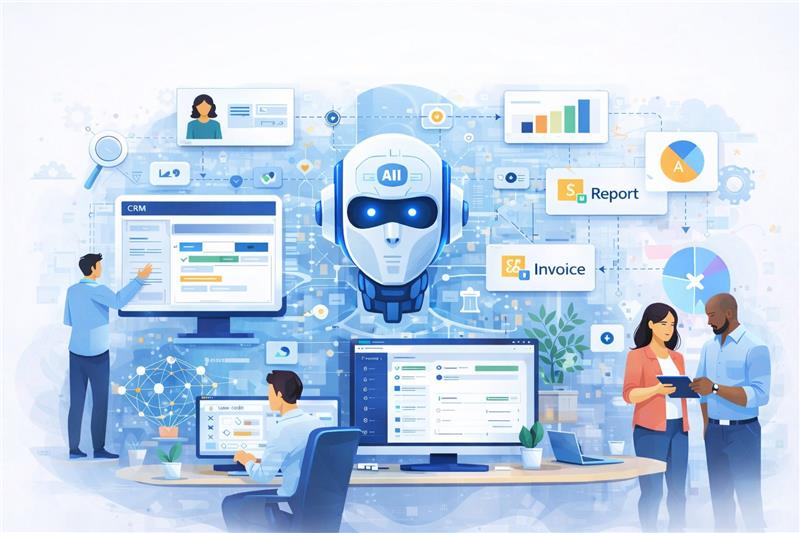
Odoo provides a single eCommerce ecosystem that supports finance, sales, inventory, human resources, manufacturing, and several other types of ERPs based on the open-source platform. Odoo is already not only a modular ERP but is turning into an intelligent business platform powered by artificial intelligence in 2026.
Following the fast progress of Artificial Intelligence (AI) and Machine Learning (ML), companies are currently using AI-enabled ERP to make decisions automatically and predict the future, decrease operational expenses, and acquire real-time insights. This is why the development services of Odoo are changing from customization to an intelligent system design.
This guide describes the roles of AI and machine learning in the future, how Odoo ERP development is being transformed in 2026, what this will entail for the business, and why it is essential to select the appropriate AI-oriented Odoo development partner to achieve long-term success.
Why AI Matters in Odoo ERP Development in 2026
The aspects of modern business are characterized by rapid shifts when the workflow cannot remain constant. AI enables Odoo to:
- Learn from historical data
- Anticipate trends and abnormalities.
- Automatize routine decisions.
- Departmental process optimization.
Companies with AI-powered Odoo ERP can predict and avoid problems rather than responding to them.
This shift has redefined how businesses evaluate Odoo development services, as intelligent automation, predictive analytics, and data-driven insights become critical success factors. As a result, many organizations are now actively recruiting Odoo developers with strong AI and ML expertise to build smarter, more proactive ERP solutions.
Integrating AI and Machine Learning to Build Intelligent Odoo ERP Systems
The incorporation of AI is no longer optional; it is increasingly a layer in the architectural design of current Odoo systems.
Oxen developers add AI models to Odoo through:
- Python-based ML frameworks
- APIs, External AI services.
- In-built automation and rule engines.
This produces smart Odoo ERP systems that conform to actual business behaviour and not logic.
Key Capabilities:
- Self-learning workflows
- Context-aware recommendations
- Automated exception handling
This approach dramatically increases ROI from Odoo ERP development services.
Using Predictive Analytics in Odoo for Better Business Decisions
One of the most significant machine learning applications in Odoo is predictive analytics.
Through the analysis of historical data, AI models would predict:
- Sales demand
- Inventory consumption
- Cash flow trends
- Customer churn probability
Business Impact:
- Better planning accuracy
- Reduced stockouts and overstocking
- Data-driven leadership decisions
Predictive analytics transforms Odoo from a reporting tool into a decision-support system.
Automating Core Business Operations with AI in Odoo
AI allows the automation of smart ERP using Odoo to minimize human participation in interdepartmental processes.
Examples:
- Auto-confirming sales orders based on risk scoring
- AI-based invoice matching and validation
- Intelligent approval workflows
In contrast to conventional automation, AI-based workflows become better with time as the system is informed by the results. That is one of the primary reasons why corporations choose AI Odoo development services and not simple customization.
If you are planning to upgrade or customize your ERP, learn how to hire the perfect Odoo developer in 2026 to ensure long-term scalability and performance
AI-Driven Human Resource Management for Smarter Workforce Optimization
The sphere of AI in Odoo development that is developing the most rapidly is Human Resource Management.
AI Use Cases in Odoo HR:
- Resume screening and candidate scoring
- Employee performance prediction
- Attrition risk analysis
- Workforce planning and skill gap detection
AI will allow the HR teams to shift to strategic talent management and enhance retention and productivity.
Improving Inventory and Supply Chain Efficiency with Machine Learning
Inefficiency in inventory is expensive. Machine learning in odoo assists the Odoo systems in constantly optimizing supply chains.
ML-Powered Capabilities:
- Demand forecasting per SKU
- Supplier performance prediction
- Automation of reordering levels.
- Logistics delay detection
ML models allow embedding companies to gain lean inventory practices and customer satisfaction.
Enhancing Customer Relationship Management Using AI Insights
Odoo CRM is a revenue intelligence platform with AI.
AI in Odoo CRM Includes:
- Lead scoring based on conversion probability
- Individual follow-up recommendations.
- Prediction of the lifetime value of a customer.
- Sentiment analysis from communication logs
Sales teams that operate with AI-powered Odoo ERP deal better and quicker
Strengthening Financial Accuracy and Fraud Detection with AI
Another domain where AI can be of great value is finance.
AI-Driven Financial Controls:
- Anomaly detection in transactions
- Duplicated or bogus invoice detection.
- Intelligent reconciliation recommendations.
- Future cash-flow forecasting.
This minimises financial risk and enhances compliance and audit preparedness.
Real-Time Business Intelligence and Smart Reporting in Odoo
Traditional dashboards show what happened. AI-powered BI explains why it happened and what to do next using advanced Odoo AI features.
Smart Reporting Features:
- Automated insights and alerts
- Trend detection across the department
- Natural-language queries
- Predictive KPI monitoring
This allows executives to do something immediately as opposed to waiting a month to get reports.
How AI Is Transforming Odoo Development and Customization
The development of Odoo solutions has been transformed by AI in Odoo development. Businesses are now building smarter, more adaptive ERP systems that go beyond traditional automation.
Modern AI-First Odoo Development Includes:
- APIs-based modular AI services.
- Custom ML models trained on business data
- Prediction-based automation policies.
- Scalable future upgrading architecture
Consequently, the number of companies that employ Odoo developers but know the architecture of ERP and AI engineering is on the rise.
The Future of Odoo ERP: AI-Powered Innovation Beyond 2026
In future, Odoo ERP can further develop as a self-optimizing enterprise platform.
Expected Innovations:
- Self-directed business processes.
- AI-based chatbots within Odoo.
- Deeper real-time analytics
- Industry-specific AI modules.
Companies that invest in the early part of AI-driven ERP solutions will have the benefit of gaining a competitive edge in the long run.
AI-Enabled Odoo ERP: Traditional vs Intelligent Systems
| Feature | Traditional Odoo ERP | AI-Powered Odoo ERP |
| Decision Making | Rule-based | Predictive & adaptive |
| Automation | Static workflows | Self-learning automation |
| Reporting | Historical data | Real-time insights & forecasts |
| HR Management | Manual evaluation | AI-driven workforce analytics |
| Scalability | Limited intelligence | Continuously improving system |
Use this comparison table to assess your business requirements and transformation goals while referencing the Official Odoo Documentation Library for reliable product guidance.
Best Practices for Implementing AI in Odoo ERP
- Start with high-impact use cases (inventory, finance, CRM)
- Use clean, structured historical data
- Combine native Odoo automation with AI models
- Maintain explainability for compliance
- Collaborate with well-established AI Odoo ERP development companies.
Conclusion
In 2026, the development of Odoo will be radically redesigned by AI and machine learning. Odoo ERP is being transformed into an intelligent business platform with predictive analytics and smart automation for AI-based HR, finance, and CRM.
Current organizations investing in the AI-based Odoo ERP development services are receiving operational efficiency and strategic insights, as well as future-ready systems. The partner and the team one selects, with the skills needed to use AI will decide the degree of value your ERP will bring.
Frequently Asked Questions (FAQs)
1. What is the AI application in Odoo ERP development?
The applications of AI in Odoo ERP systems include predictive analytics, workflow automation, fraud statistical work, demand forecasting, and intelligent reporting.
2. Do I need to hire a specialized Odoo developer for AI projects?
The AI-based projects would need people, who are proficient in Odoo framework, Python, APIs, and machine learning integration.
3. Does Odoo ERP with AI make sense to SMEs?
Absolutely. Automation, reduction of costs, and enhancement of decision-making without high overheads in large enterprises are advantageous to SMEs.
4. Is it possible to add AI to an existing Odoo?
Yes. AI modules and integrations can be added incrementally to existing Odoo implementations.
5. What are the industries where AI is most useful in Odoo ERP?
The organizations that experience the greatest ROI of AI-driven ERP solutions include manufacturing, retail, logistics, finance, healthcare, and businesses that are service-based.